Rank trackers have been getting “poisoned” Google results since September, according to a Nozzle study dated October 10. Its headline 8.0% is a share of the SERPs Nozzle could judge, not of the 27.5 million in its header. Nozzle and Morningscore each report rates that differ by the route or data provider the results came through.
What is a poisoned SERP?
Nozzle’s research page defines a poisoned SERP: “A SERP is poisoned when fewer than half of its keyword’s usual sites appear anywhere on it, and they come back on a later SERP.” Nozzle reports 8.0% of SERPs poisoned since September 13, against 0.17% in its baseline of August 20 to September 9, and its method counts only the SERPs it could judge. Nozzle writes that the SERPs that came through “were normal until September 20, when poisoned SERPs first appear.”
What the 8.0% Is a Share Of
Nozzle’s header tiles show “27.5M” for SERPs analyzed and “8.0%” for SERPs poisoned. The two figures do not share a base. Summing Nozzle’s published daily file, 1,414,466 poisoned SERPs sit among 17,767,967 judged SERPs since September 13. That is the 8.0%.
The same file holds 27,523,930 SERPs for that period, which is the 27.5M. About 9.8 million of them were never judged. Nozzle’s method section says “only those keywords’ SERPs are judged”: keywords with five or more SERPs in the baseline, from which Nozzle derives each keyword’s usual sites. The unjudged SERPs were not found clean. They were not classified. Against all 27.5 million, the classified poisoned SERPs are 5.1% by our sum, and neither the 8.0% nor the 5.1% is a rate for Google requests in general.
The definition also builds in recovery. A SERP counts only if the usual sites come back on a later SERP, so a result set that changed and stayed changed is not counted.
Four Vendor Pages, Four Descriptions
Four vendor pages, dated October 7 to 10, describe the problem in four ways. Only two give start dates, and the dates differ.
| Vendor and date | What it reported |
|---|---|
| Nozzle, October 10 | SERPs missing most of a keyword’s usual sites, first seen September 20. 8.0% since September 13; “a quarter of all SERPs” on September 27 to 29. Its daily table peaks at 27.0% on September 29. |
| Morningscore, October 8 | Results it calls “truncated”, from 22:10 UTC on September 24: fewer than 40 results instead of about 50, in about 60% of its searches on September 30 and October 1. |
| Sistrix, October 7 | Results that “differ significantly from the regular search results”, seen since September. No rate and no day-level dates. |
| DemandSphere, October 7 | “~11% of our daily SERPs”, on its “current measurements”. The post gives no definition, method, date range or sample size for the figure. |
The 8.0% and the 60% count different things on different bases, and DemandSphere’s post does not say how its ~11% is measured. The three numbers are not a range.
The Rate Changes With the Route
Nozzle reports that on the same days, from September 30 to October 9, one route it collects through returned 1 to 7% poisoned SERPs and another 9 to 30%. Morningscore reports that when truncated results came back on October 2, one data provider got them for up to 72% of searches while its new provider got them for 1 to 3%, “for the same keywords at the same time.” Morningscore also ran the same searches in a normal Chrome browser from Danish connections and got full results. Nozzle’s page reports no browser comparison.
The Same Weeks as the Spam Update
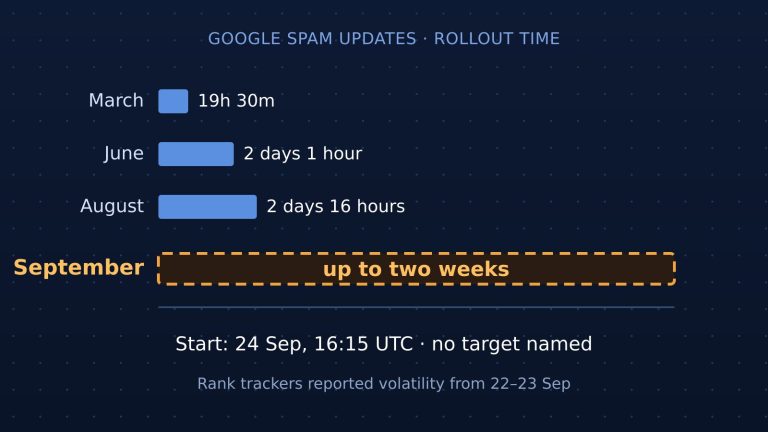
Google’s status dashboard logs the September spam update as rolling out from 16:15 UTC on September 24 to 08:00 UTC on October 8. Our September 25 post recorded volatility the tracking tools showed before the update began.
By our sum of Nozzle’s file, 1,323,477 of the 1,414,466 poisoned SERPs (93.6%) fall on the UTC days from September 24 to October 8. Those days hold 68.0% of the SERPs judged since September 13. Leaving out September 24 and October 8, when the update ran for only part of the UTC day, 86.4% of the poisoned SERPs fall on the days in between. The file also counts 43,644 poisoned SERPs on September 20 to 23, the four days before the update began. On October 9, the day after the rollout ended, the file still shows 4.24% of judged SERPs poisoned, and Nozzle notes that “the last three days are still filling in.” Nozzle’s page does not mention the update.
The dates alone do not say whether the update is involved, or whether that earlier volatility was related. Morningscore, which compared its searches with a browser, reads its own data this way: “That points to Google treating automated searches differently, not to a ranking update.” It adds: “We can’t prove that from the outside, but it’s what the data shows.” Morningscore’s notice does not name the spam update. It also says that normal-length results “changed more than usual during these days” and that “Some of that may be real ranking movement.”
Motive: No Google Statement Cited
None of the four vendor pages cites a statement from Google. Morningscore writes: “Google hasn’t said.” Nozzle’s page states a motive as fact: “It is Google’s response to AI scraping, and rank trackers are caught in it.” Sistrix, writing about collection getting harder since 2025, says: “We believe Google’s main aim is to make it harder for new competitors such as ChatGPT to access its search index and to prevent search results from being used to train open-weight AI models, for example from China.” Barry Schwartz of Search Engine Roundtable says he does not think Google is acting to block the tools SEOs use “but rather to go after AI bots and SerpApi.”
Telling a Poisoned Reading From a Ranking Change
Five checks from Nozzle’s page and Morningscore’s notice:
- Compare with the keyword’s usual page-1 sites over the previous weeks. Nozzle warns that “yesterday may have been poisoned too.”
- Wait a few days. Nozzle says “A real ranking change stays”, and reports that 77.9% of poisoned SERPs have their usual sites back within three days.
- Open Search Console’s Performance report. Nozzle: “If a site “disappears” and Search Console still shows impressions and clicks, nothing happened to the site.”
- Check the date window. Morningscore: “If your rankings dropped between September 24 and October 2, check again before you act.”
- Do not expect the page to give it away. Nozzle: “Nothing in the HTML marks it.”
Then ask your tool vendor which routes or providers collect your data, and whether suspect results are discarded or stored. Nozzle notes that a refused request “tells a scraper to try again, while a poisoned one gets stored as real.” Morningscore says its tracker recorded truncated results “as real ranking drops” until it began discarding them around 10:20 UTC on September 30. Sistrix says it now publishes only results that have passed additional checks, and has switched off on-demand updates.