Google published a documentation page for the UGC Fresh Data Program, a dedicated pipeline that lets approved platforms push content and engagement signals straight to Google. It sits apart from both crawling and the Indexing API. The asymmetry: the platform must build OAuth 2.0 authentication and strictly validated JSON-LD payloads, while Google publishes no number behind “high volume” or “significant user base” and promises no placement.
What is the UGC Fresh Data Program?
Google’s documentation calls it “an initiative designed to help platforms display fresh, high quality, and authentic user-generated content (UGC) across various features on Search.” Approved platforms “can use a dedicated data ingestion pipeline to send content and interaction signals to Google.” The page calls it a pipeline “designed exclusively for trending UGC content” and “independent of the Google Indexing API and traditional organic crawling for general web content.”
The page went live as a new entry in the Search Central changelog on October 8. We found no blog post or launch announcement. Search Engine Roundtable covered it the same day.
| Lane | Covers | How content arrives |
|---|---|---|
| Crawling | General web content | Googlebot fetches |
| Indexing API | JobPosting; BroadcastEvent in VideoObject | URL notice, then crawl |
| UGC program | Trending UGC content | Push, approved only |
The Platform Carries the Engineering
Eligibility is a list of obligations. The platform “must primarily host UGC, social postings, or forum discussions,” on dedicated pages with stable URLs, “not on profile or feed pages.” Content must sit on public pages, and every item must be attributable to a creator with a public profile. Moderation is required, “including a user reporting mechanism.”
Then the technical part. The owner needs “secure OAuth 2.0 API authentication” and “strictly validated JSON-LD payloads,” plus valid on-page schema.org markup. The doc’s example is SocialMediaPosting or DiscussionForumPosting with interactionStatistic sub-fields, and it is an example, not a closed list. Anyone who has fought escaping bugs should read how Google unescapes JSON-LD only once before generating that on-page markup.
Freshness is the expensive clause. Content should be “ideally sent within minutes,” and engagement counters need regular updates “within 72 hours of creation.”
No Published Threshold, but the Form Asks for Numbers
The page says participation is limited to platforms meeting “specific content quality and volume guidelines.” It never puts numbers on them. Yet the application form asks how many monthly active users the platform has, when it launched, for 10 sample URLs and for a Search Console owner email. What Google does with the MAU answer is not disclosed.
Google will answer “within 6-8 weeks” and says that submitting “doesn’t guarantee participation.” On serving, the page is blunt: “This program doesn’t guarantee that content will appear in Search.” No participants are named, and no fees, rate limits or processing times for submitted content are listed.
After You Send Content, Nothing Is Publicly Documented
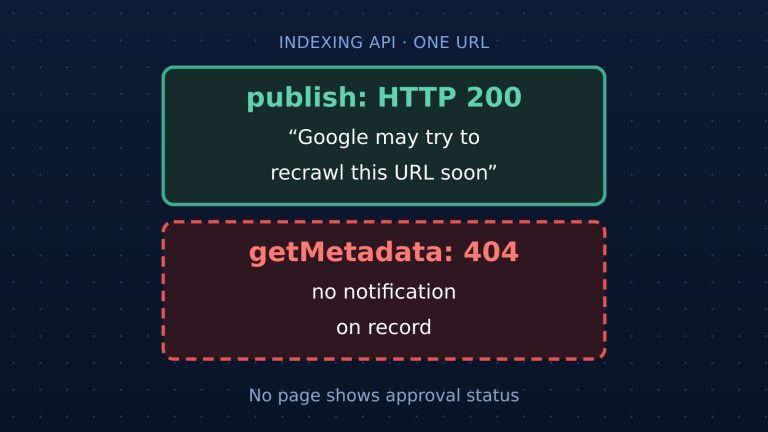
Developer documentation arrives only after acceptance. The public page therefore describes no way to see what happened to a submission. The Indexing API quickstart at least documents a call for the last notification Google received per URL, and even that left operators guessing, as we covered in the Indexing API case where approval had no status page. Whether this program has a similar call is unknown, because the specs are private.
Who Should Care
Forums, Q&A sites and social apps with open, attributable posts are the audience. Ordinary blogs and brand sites are not: the page targets platforms that “primarily host UGC.”
The markup half is regular structured-data work, and a forum can do it now: stable post URLs, creator profiles, interactionStatistic counts that match the visible page. The push pipeline is the costly half, and its spec stays private until Google says yes. Build the markup first; apply once the counters are accurate.