Shopify announced the Universal Commerce Protocol (UCP) in January 2026—an open standard designed to let AI agents connect to and transact with merchants. Combined with the company’s broader Sidekick AI rollout, the move positions Shopify as infrastructure for agent-mediated commerce. The trajectory is now clear: the company is betting that AI shopping assistants will become a meaningful sales channel before 2028.
The Universal Commerce Protocol
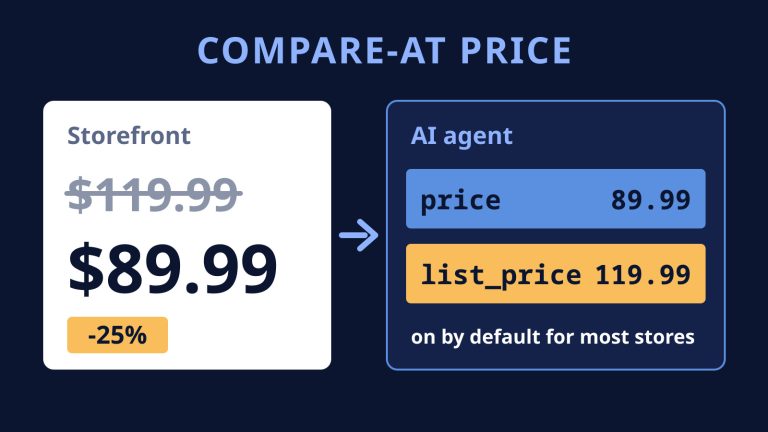
UCP was co-developed by Shopify with launch partners as an open standard. The protocol exposes merchant inventory, pricing, shipping, and policy data to AI agents through a uniform interface. The economic logic: rather than each agent building bespoke integrations with each merchant platform, agents can talk to UCP-compatible storefronts using a shared schema.
For Shopify’s 5+ million merchants, UCP-compatible storefronts opt into agent visibility. When a user asks ChatGPT or another agent to “find a navy linen blazer under $200 from a brand that ships to Canada,” agents with UCP access can surface matching SKUs and—where the integration is wired through—initiate checkout flows.
Sidekick AI as the Merchant-Side Layer
Where UCP is the consumer-side agent layer, Sidekick is the merchant-side AI assistant. Sidekick has been progressively rolled out across Shopify admin surfaces. The capability set as of 2026 includes:
- Catalog operations — bulk updates, promotion scheduling, and inventory queries via chat interface
- Multi-step workflows — single-instruction execution of compound tasks
- Theme editing — natural-language layout adjustments without HTML or Liquid knowledge
- Multilingual coverage — capability across multiple languages for merchant operations
The Merchant Trade-Off
Agentic sales bypass merchant-controlled brand storytelling. A buyer who completes purchase through ChatGPT doesn’t see your landing page, your testimonials, or your upsell carousel. For merchants whose conversion depends on storefront merchandising, that’s a meaningful trade-off. For merchants whose products are bought on spec—commodity SKUs with predictable specifications—it’s pure upside.
Three considerations for merchants weighing agent-channel exposure:
- Catalog quality — agents rely on structured product data; sloppy taxonomies and inconsistent attributes hurt discoverability
- Brand-discovery dependency — if your conversion needs the user to see your brand, agentic checkout will compress your funnel
- Margin economics — Shop Pay transaction fees apply equally to agent-driven and web-driven sales
The Broader Payments Stack Is Moving
Shopify isn’t moving alone. Stripe, PayPal, and Adyen have all signaled or shipped related agentic-checkout patterns through 2025-2026. The pattern is becoming a baseline layer of payments infrastructure rather than a Shopify-specific bet. What Shopify gets from being aggressive: distribution to its 5+ million merchant base on day one of each capability rollout.
Where the Strategy Points
The April 2025 internal memo from Tobi Lütke—that Shopify hires should justify why AI couldn’t do the job—signals the same direction internally that UCP signals externally. Shopify is repositioning around AI-mediated commerce as the substrate, not as a feature. Whether agent-mediated sales reach the trajectory the company has staked on remains an open question through 2026-2027.
For merchants planning their 2026-2027 channel strategy, the practical question is whether to opt in early or wait for the pattern to mature. Opt-in is reversible, free, and gives optionality. For broader context on how AI is reshaping commerce, see Google’s AI-powered Shopping Ads evolution.