Pinterest announced Visual Search Ads on 17 September 2026 at Pinterest Presents, its annual advertiser summit in New York. The format places paid results inside Pinterest’s own search results and Pin closeups, alongside same-day announcements of Performance+ Priority Products, self-serve A/B testing, a dedicated App Promotion objective and a consumer feature called Restyle.
What are Pinterest Visual Search Ads?
Visual Search Ads are a new Pinterest ad format that places advertisers directly in Pinterest Search Results and Pin closeups, the screens people reach as they search and compare. Pinterest says advertisers can bid for a top response and connect people directly to an advertiser’s site, pairing keyword relevance with the format to reach people while they are still shaping what they want. The company says the format supports lower-funnel objectives and is compatible with Pinterest Performance+, which it calls its AI-powered performance advertising suite.
Where the Ads Sit, and What Shipped Alongside Them
Pinterest describes the placement as reaching people as they “search, compare and move closer to a decision,” pairing keyword relevance with what it calls “a distinctive new ad format.” CEO Bill Ready framed the shift in AI terms: “Traditional search advertising has long relied on keywords, but in an AI-driven world, people are expressing themselves in much richer ways. Visual Search Ads allow marketers to tap into this new and rapidly growing form of AI-powered search with a prominent placement at the critical decision points where people see, save and decide.” Pinterest says the signals it makes actionable for advertisers through visual search come from Pinterest Intelligence, which it describes as its “AI-enabled visual understanding of images, products, taste and intent.”
The company backs the pitch with scale: more than 80 billion searches a month, most of them visual and over half commercial. That is Pinterest’s own count, which The Next Web reports Pinterest sourced to its second-quarter earnings. The same event added Priority Products to Performance+, letting advertisers flag items for a seasonal push while automation keeps running, plus self-serve A/B testing across creative and targeting, and a purpose-built App Promotion objective now in global beta with qualified advertisers.
A Year Apart, One Number Missing
Pinterest already sells ads inside search results. It introduced Top of Search ads a year earlier, on 25 September 2025, describing them as appearing “directly within the top ten search results and in Related Pins.” That launch shipped with numbers. Pinterest’s own testing found “an average click-through rate 29% higher for Top of Search ads compared to standard campaigns, and a 32% higher likelihood of attracting new clickers,” and Pinterest named Wayfair as an early tester, reporting “a 237% increase in click-through rate over a two-week period compared to their usual campaigns.” The Visual Search Ads announcement, a year later, carries no equivalent figure for the format itself. The only efficiency number on the page belongs to a different product, App Promotion, where Pinterest credits one advertiser with “up to an 85% improvement in cost per install compared to previous workarounds.”
No Reporting Line, No Date
Bill Ready’s summit remarks promised “an ads platform that’s more relevant, more measurable and easier to use.” The announcement is built on keyword relevance; it supplies nothing for the measurable half. Pinterest published no eligibility criteria for “eligible advertisers” and no date beyond “the coming weeks.” Even the rollout is described differently depending on who wrote it. Pinterest’s own post describes availability “in all Pinterest ad markets,” a phrase The Next Web matched as “every Pinterest ad market,” while Social Media Today’s write-up narrowed the same beta to “selected markets over the next few weeks.”
The gap widens in the documentation. Pinterest’s help center page on ad reporting lists Spend, Impressions, Pin clicks, Outbound clicks, cost per result and CTR, viewed by campaign, ad group, ad or keyword; it names no placement or format breakdown. The developer documentation does carry a placement token among its breakdowns, though that page does not document which values it returns. Nothing on record, in either place, promises Visual Search Ads a row of its own.
Tag the Destination URL Before the Beta Lands
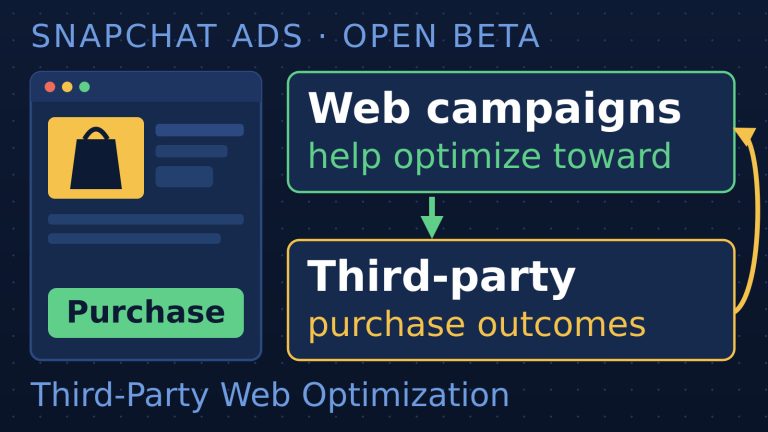
Pinterest says the format can connect people directly to “an advertiser’s site,” which puts the measurement an advertiser fully controls on their own domain, not inside Pinterest’s dashboard. Consistent UTM parameters on every destination URL are what let an advertiser separate the campaigns they run in the beta from ordinary Pinterest referral traffic once the beta arrives, a step our campaign URL builder handles without guesswork over naming. Snapchat ran a similar play this month with its third-party web optimization beta, pushing another performance signal onto the advertiser’s own site. For now, the destination URL is the only place an advertiser can label Visual Search Ads clicks themselves.