Pennsylvania’s Artificial Intelligence Deceptive Advertising Act was approved by the Governor on Oct. 22 as Act No. 99 of 2026, and it requires an AI label only where synthetic content creates a false consumer perception about the nature, origin or authenticity of the goods or services advertised, not on every ad made with AI. The bill is Senate Bill 806; the bill page records the approval and the act number.
Which AI ads need a label under Pennsylvania’s law?
An ad needs a label when it uses synthetic content in a manner that creates a false consumer perception about the nature, origin or authenticity of the goods or services advertised. The statement must say the ad contains content modified or generated using artificial intelligence. Content limited to text, evidently fictional, or parody, satire, commentary or criticism is exempt.
How the Act changed from the first bill
The version filed on June 3, 2025 was broad. Its operative clause reached “any content generated by artificial intelligence” without disclosure, “including written text, images, audio and video content”. On May 6, 2026 a Senate committee replaced it with a standalone act: an advertiser rule, a false-perception trigger, three exceptions, and enforcement by the Attorney General or a district attorney.
The Verge’s report on the signing says the law requires any ad that “has been significantly modified or generated by artificial intelligence” to include a label, “whether it’s a still image, video, audio, or text”. The enacted text, Printer’s No. 1808, lists “limited to text” among its exceptions in Section 4(b)(3). The Verge also notes, further down, that the wording suggests only content that creates a false perception about a product or service would require a disclosure.
One more change is easy to miss. The first bill began its rule with “Knowingly or recklessly”, and the May draft said an advertiser may not “knowingly, recklessly or willfully” create and disseminate such an ad. The sponsor, Sen. Nick Pisciottano, offered amendment A03593, which strikes those three words, and the Senate adopted it 48 to 2 on June 10. The signed text therefore names no state of mind. The amendment itself states no reason for the change.
What the label has to do, and when it starts
Section 4(a) sets three requirements for the disclosure. It must be displayed “in the first instance” whenever the synthetic content is presented to the consumer, presented in the same medium as the synthetic content, and, “to the extent technically feasible”, permanent or extraordinarily difficult to remove. Section 3 defines “clear and conspicuous” through six criteria; the first covers a size, color, contrast, location, duration and audibility that is “readily noticeable, readable, understandable and capable of being heard”.
The Act names the Attorney General and district attorneys as enforcers, and a court may award a civil fine that does not exceed $3,000 plus attorney fees and costs. Section 4(c) adds that disclosure of the use of AI “shall not be construed to limit any recourse under law”. The Act “shall take effect in 60 days”. By our count from Oct. 22 that is Dec. 21, which is our arithmetic and not an official date. On Oct. 6 the House rejected, 100 to 103, an amendment that would have moved the start from 60 to 120 days. An Oct. 7 release from Pennsylvania Senate Democrats announcing final passage said Pennsylvania “will become one of the first states in the nation to establish AI disclosure requirements aimed at protecting consumers from deceptive advertising”.
Platform-written creative: the open questions
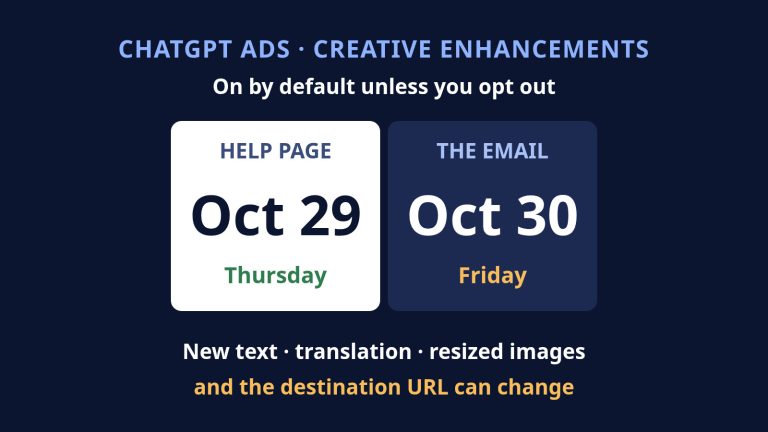
The Act speaks of an “advertiser” who creates and disseminates, or causes to be created and disseminated, an advertisement. It does not define “advertiser”, and it does not mention platforms, ad networks or AI tool providers. That matters when an ad platform’s own tools change the creative. OpenAI’s help page says ChatGPT Ads’ creative enhancements switch on by default from Oct. 29 (OpenAI’s email to advertisers says Oct. 30); the changes can include headlines, descriptions, image resizing and translation, and ads can run without per-version approval. Most of that list is text. Whether any of it counts as synthetic content that creates a false consumer perception is a question the Act leaves open.
The same goes for mixed ads. The Act exempts content “limited to text” and says nothing about AI-written copy sitting next to a real photo, or about where “significantly modified” begins for a background swap.
Visible labels raise a third question. Microsoft’s AI content policy says its machine-readable provenance marking “may not appear as a visible label” and leaves visible disclosure to applicable law. The Act asks for a statement that is readily noticeable and readable. It does not say whether any platform tag counts. The IAB’s AI disclosure framework exempts ad copy, but it is a trade-body recommendation, not a statute.
What the Act says and what it leaves out
The left column summarizes or quotes Printer’s No. 1808; the right column lists what that text does not address.
| What the Act says | What it doesn’t say |
|---|---|
| A label is owed where synthetic content creates a “false consumer perception about the nature, origin or authenticity” of what is advertised | Who counts as an “advertiser”; platforms are not mentioned |
| Exempt: content “limited to text”, “evidently fictional”, and “parody, satire, commentary or criticism” | Whether “limited to text” means the whole ad or only the AI-made part |
| The statement must say the ad contains content modified or generated using artificial intelligence, shown “in the first instance” and in the same medium | Exact label wording, or whether a watermark or metadata can meet “readily noticeable, readable” |
| Enforcement by the Attorney General or a district attorney; a fine that “does not exceed $3,000” | How violations are counted, or any rule on where an ad was made |
| “Take effect in 60 days” (by our count, Dec. 21) | A defined test for “significantly modified” |
Checks to run with counsel
This is not legal advice. For anyone who buys or approves ads, the practical questions are narrow and can be put to counsel before the start date.
- Which AI-made images, video or audio could give a Pennsylvania consumer a false perception about the nature, origin or authenticity of what you sell? The Oct. 7 release gives this example: “an AI-generated image that could lead consumers to believe they are seeing an actual product”.
- For those pieces, would your label meet the “clear and conspicuous” definition, in the same medium, from the first showing?
- Which platform defaults alter creative after you approve it, and is a human reviewing the output that reaches users?
- Does anything rely on a caption field or invisible metadata as the label? Treat that as unresolved until counsel says otherwise.