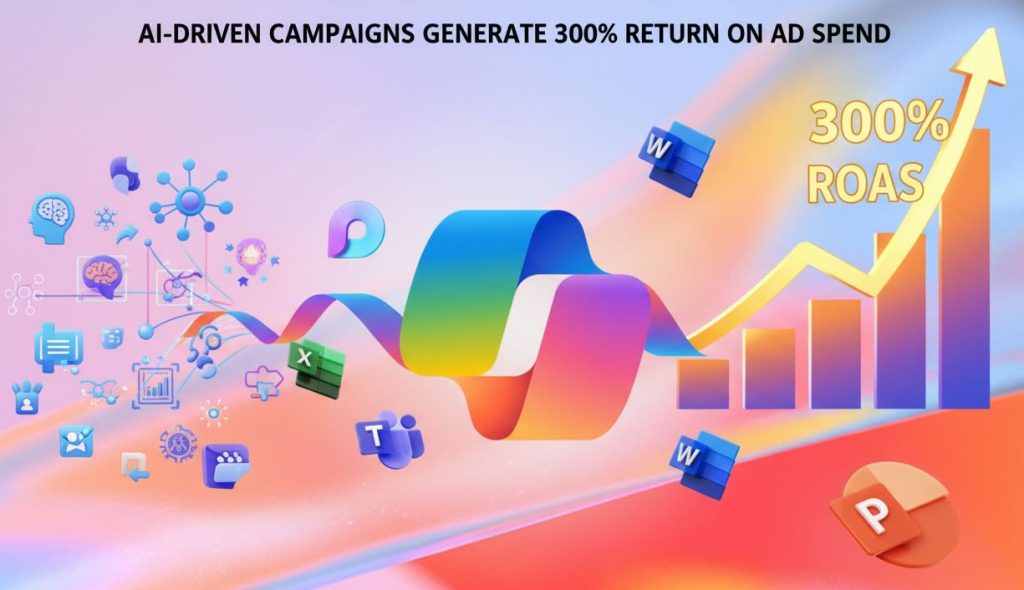

Microsoft is rebuilding its advertising business around Copilot, pairing AI-assisted campaign creation with Performance Max campaign automation that decides which ads to show, where and to whom across the Microsoft Advertising Network. Copilot in the Microsoft Advertising Platform uses generative artificial intelligence to draft text, image and video assets from an advertiser’s landing page, positioning Microsoft as a more serious challenger to Google’s advertising dominance through intelligent automation.
Performance Max replaces ad-by-ad setup with asset groups. Advertisers supply the inputs—headlines, descriptions, images, audience signals and optional search themes—while Microsoft AI chooses which combinations to serve across search, audience and Product ads, from Bing to Microsoft-owned properties such as MSN and Outlook. The campaigns do not use keywords, and search campaigns with exact match keywords keep priority in the auction, so an existing search program is not pushed aside by default.
Audience Reach and B2B Targeting
For B2B advertisers, the clearest advantage is Microsoft’s ownership of LinkedIn. Microsoft Advertising lets advertisers adjust bids using LinkedIn profile data—company, industry and job function—in search, shopping and audience campaigns, a professional signal Google cannot match. The targeting works as a bid adjustment rather than a hard filter, so it concentrates spend on the most valuable professional audiences without shrinking reach.
The platform’s integration across Microsoft’s ecosystem lets marketers manage optimization from one place, with AI tailoring which assets appear for each query or placement while the industry rethinks SEO through answer engine optimization (AEO). Advertisers gain a lighter manual workload, though some are uneasy about handing creative and strategic control to algorithms; brand exclusion lists and account-level negative keywords remain the main levers for keeping Performance Max in check.
Competitive Positioning and Market Strategy
Microsoft’s AI advertising expansion challenges Google directly by offering comparable automated campaign management, with LinkedIn data as the B2B edge its rival lacks. The company’s partnership with OpenAI underpins Copilot’s conversational experience, giving Microsoft an early position in AI-mediated search, where ads have to fit naturally into answers instead of sitting beside a list of blue links.
Ads already appear inside Copilot’s conversational answers, and Microsoft has been testing richer, more interactive formats for that placement. This raises questions about the future of traditional SEO while creating new opportunities for advertisers to reach audiences through AI-mediated interactions rather than conventional search result placements.
Strategic Business Implications
Microsoft’s push shows how far advertising has moved toward AI-first approaches that prioritize algorithmic optimization over manual campaign management. Copilot’s asset generation lowers the cost of producing creative variations, so smaller brands can test more combinations without a dedicated design team, and its performance summaries and diagnostics help them spot spikes, drops and tracking problems faster.
Results still depend on the inputs. Microsoft’s own guidance warns that campaigns go through a learning period after every significant change, and the quality of conversion tracking decides what the system actually optimizes for. As customer journeys fragment and expectations for personalization rise, Copilot and Performance Max give businesses a scalable way to run personalized advertising, provided they judge it by measured outcomes rather than take automation on trust.