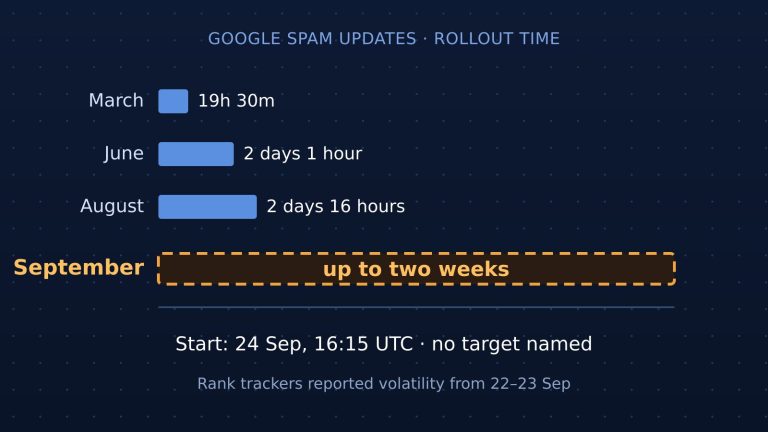

Google’s June spam update completed on June 26, after starting at approximately 9:00 a.m. PT on June 24. The rollout ran roughly 48 hours, covers all languages globally, and operates through SpamBrain, Google’s AI-based spam-prevention system. Google posted no new policies alongside the update and disclosed no breakdown of targeted violation categories.
Did the June spam update penalize AI-generated content?
No. Google does not penalize content for being AI-generated. The June update is a standard SpamBrain enforcement cycle: global, all languages, June 24 to 26. What the active enforcement framework targets is manipulation of AI citations and rankings, not AI authorship.
What Google Said About This Update
Google’s announcement was brief:
“Released the June 2026 spam update, which applies globally and to all languages. The rollout may take a few days to complete.”
— Google, June 24, 2026
Google also described the update as “improvements to the automated systems that detect spam, including SpamBrain, its AI-based spam-prevention system.” No category breakdown accompanied the release. No new policy text was introduced. The framing is routine: improved detection capacity under the existing enforcement framework, not a shift in enforcement scope. For practitioners, that distinction matters. There is no new rule to comply with, only a stronger system enforcing the policies already on the books.
The Standing Policy SpamBrain Is Now Enforcing
The policy context for AI citation tactics predates this update. On May 16, 2026, Google formally extended its spam policies to cover AI Overviews and AI Mode. Google’s spam policy now explicitly covers gamed AI answers, treating manipulation of generative search citations under the same framework as inauthentic links. Google has applied that logic to link spam for years: signals built to manufacture authority, rather than reflect genuine merit, fall outside policy. SpamBrain runs that enforcement live.
May 16 was a policy documentation event. The June update sharpens SpamBrain broadly, which includes the systems that enforce that policy. Tactics that were quietly accumulating AI citations now sit closer to active detection.
At-Risk Tactics vs. Safe Practice
No Google disclosure connected this specific update to individual tactic categories. The May 16 policy defines the enforcement boundary. Based on that framework:
| Tactic | Status | Basis |
|---|---|---|
| Paid-mention networks structured to generate AI citations | At risk | Inauthentic-link framework, now extended to generative results |
| Biased “best of” listicles engineered to target AI citation logic | At risk | Manufactured authority signals, not genuine content depth |
| Recommendation poisoning (instructing AI models to treat specific sites as authoritative) | At risk | Manipulation of generative AI responses, per May 16 policy |
| AI-authored content | Safe | Google does not penalize AI authorship |
| Structured data, verified facts, answer blocks matched to query intent | Safe | Standard GEO practice: earns AI inclusion through genuine usefulness |
One row in the safe column has shifted in meaning since spring: Google stopped showing FAQ rich results on May 7, so generating FAQ schema is now about keeping answer blocks machine-readable and identical to the visible page, not about snippet real estate.
The exposure extends beyond standard blue-link rankings. Google’s spam framework now covers AI Overviews as a measurable traffic channel, and industry commentary holds that removal from the AI-citation pool is a real risk, not a secondary effect.
For sites with meaningful AI Overview presence, pulling your current ranking and AI-citation data now is the sensible first move.