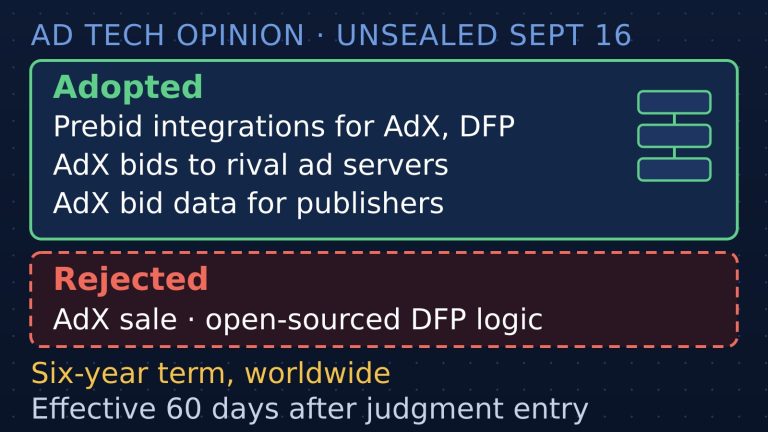
Judge Leonie Brinkema on September 2 turned down the Justice Department’s push to break up Google’s ad tech business, rejecting the sale of its AdX exchange, the open-sourcing of DFP’s final auction logic, and a contingent sale of the rest of DFP. The public order is short, two pages according to PPC Land, and its operative language is blunt: the structural remedies “be and are REJECTED.” Most of the parties’ proposed behavioral remedies, as modified by the court, “be and are ACCEPTED” instead. Which modifications survived is the part nobody outside the case can answer yet.
What did the court decide?
Judge Leonie Brinkema rejected the Justice Department’s request to force Google to divest its AdX ad exchange or open-source DFP’s final auction logic, ruling the structural remedies “REJECTED,” according to the order. She accepted most of the parties’ proposed behavioral remedies instead, with modifications the court has not yet disclosed. The ruling covers relief only; Brinkema’s April 2025 finding that Google illegally monopolizes the publisher ad server and ad exchange markets stands separately, and Google has said since then that it intends to appeal that finding.
The list everyone is citing, and why it isn’t the order
Most coverage of the ruling has settled on a specific set of fixes: real-time access to AdX bidding data for rival ad servers, an end to Unified Pricing Rules, which currently require publishers to set one price floor across every bidder inside Google Ad Manager, and a ban on Google’s “first look” and “last look” advantages in open-web display auctions. Those items are real, but they are proposals, not text from the order. The parties had proposed versions of them during remedies briefing; Google’s own submission reportedly offered real-time bid access, dropping Unified Pricing Rules, a commitment against reinstating first and last look, equal latency for competing systems, and no differentiated revenue share tied to which ad server a publisher picks. The order’s “most of” phrasing leaves open that some proposals, or some of Google’s conditions on them, did not survive. Any changes to Unified Pricing Rules would land inside Google Ad Manager, the same publisher-facing product Google recently equipped with a Gemini-based publisher agent, so a rewrite of its pricing rules would touch a tool already mid-overhaul.
Why Brinkema passed on a breakup
The two-page public order gives no reasons; the reasoning, as PPC Land describes it, rests on practicality, not sympathy for Google. There is no obvious buyer for AdX: a Microsoft acquisition would likely trigger its own antitrust review, delaying relief rather than delivering it. In that account, the ad tech market moves faster than a divestiture timeline could track, and appeals of a structural order would probably stretch relief out for years. A forced breakup also risked collateral damage to smaller publishers who depend on Google’s free DFP tier. AdX itself takes roughly 20% of each transaction as its cut, per figures reported by Reuters and Search Engine Roundtable.
Reactions split along predictable lines
Google’s public statement leaned entirely on the rejected breakup. Lee-Anne Mulholland, the company’s vice president for regulatory affairs, framed the outcome as protection for small businesses, in a statement reported by TechCrunch:
We’re very pleased the Court rejected the DOJ’s proposal to break apart tools that help small businesses reach new customers and grow.
— Lee-Anne Mulholland, Google’s vice president for regulatory affairs
Reaction beyond Google was more mixed. Digital Content Next, in PPC Land’s coverage, treated the ruling as putting Google on the hook to deliver the fixes it offered during the case. Jay Friedman, co-founder of CartographAI, was skeptical in comments to AdExchanger, saying it remains unclear how publishers on rival ad servers would get functional access to Google’s buy-side demand, as opposed to access on paper.
What’s still pending
The Memorandum Opinion explaining which remedies were modified, and how, is currently sealed; either side can request redactions within 14 days, and it unseals automatically if neither does. Thirty days out, the parties owe the court a joint proposed final judgment, with disagreements flagged but not argued in that filing. None of that exists yet, so there is no enforceable final judgment, only an order describing what was rejected and what was accepted in principle. The case sits alongside a structurally similar one: in a separate search antitrust matter in September 2025, Judge Amit Mehta likewise declined to order a Chrome divestiture, settling on behavioral terms covering search data sharing and default-placement deals. Ad auction mechanics are under scrutiny in an unrelated case too: the FTC’s separate lawsuit accuses Amazon of adding a hidden surcharge on top of the second-price ad auction it advertised, a different regulator, court and market. The European Commission’s own ad tech case against Google, a €2.95 billion fine in September 2025 plus Google-filed commitments that November, is a third track running in parallel.