Apple told developers on September 16 that it is changing App Tracking Transparency in the European Union. Beginning with iOS 27.2 and iPadOS 27.2, apps will have the option to show an alternative version of the ATT permission prompt to EU users, and for apps distributed in five countries that alternative is the only version available. Apple says the underlying rule, when an app must ask before tracking, stays the same.
What is changing in Apple’s ATT prompt in the EU?
Starting with iOS 27.2 and iPadOS 27.2, apps get the option to show a reformatted App Tracking Transparency prompt to users in the European Union, with an optional text button labeled “Additional Information.” For apps distributed in Germany, France, Italy, Poland and Romania, that alternative prompt is the only version available. Everywhere else in the EU, the developer chooses between the original alert and the new prompt, and EU users can be re-asked one year after their previous answer, whether they said yes or no, unless they have turned off app tracking requests in their device’s Settings.
Two Tiers Inside the EU, One Mandatory List
Apple’s change applies only inside the EU. Outside it, nothing changes: the system alert still shows the original purpose string, and the new parameters have no effect, according to Apple’s API documentation. Apple says the changes come “as part of agreements with select European competition authorities” without naming any. On August 17, Germany’s Bundeskartellamt announced that it had declared binding the commitments Apple offered on ATT, including that “the design of the consent prompts will be neutral in terms of content, wording and layout.” Apple’s announcement does not mention that decision.
Inside the EU, Apple’s two documents describe the split differently. The policy page talks about apps “distributed in” a country; the API documentation says the new behavior requires the device to be located in a specific EU country and signed in with an Apple Account set to an EU country or region. For most member states, using the alternative prompt is optional. In Apple’s new request method, a boolean parameter, preferExpandedInterface, requests “a full-page sheet instead of a system alert,” in Apple’s words. Apple’s developer news post is blunter about the other five: “Due to legal requirements, only the alternative version of the system prompt is available for apps distributed in Germany, France, Italy, Poland, and Romania.” The API documentation adds the mechanics: in those five countries, the system shows the full-page sheet “regardless of what you set for preferExpandedInterface.” The sheet-or-alert choice disappears there.
| Region (per Apple’s API documentation) | What the system shows | Additional Information button |
|---|---|---|
| Germany, France, Italy, Poland, Romania | Full-page sheet, regardless of preferExpandedInterface |
Shown if the developer supplies an action |
| Rest of the European Union | Full-page sheet only if preferExpandedInterface is true; otherwise a system alert |
Shown if the developer supplies an action |
| Outside the European Union | Standard system alert, unchanged | Not shown |
The One-Year Re-Ask Cuts Both Ways
The other EU-only change is symmetric. Apple’s policy page says developers “can reprompt a user via the App Tracking Transparency system prompt one year after the user’s previous choice in your app’s App Tracking Transparency system prompt, regardless of whether that choice was to accept or reject.” The API documentation confirms iOS enforces the clock itself, not the app: “the system notes the date and doesn’t allow the prompt to display again until a year passes.”
Apple’s general ATT guidance, which applies everywhere, points developers to a shortcut to Settings when a user has turned tracking off for their app. Apple names one exception to the EU re-ask: a user who has turned off “Allow Apps to Request to Track,” renamed “Allow Apps to Request to Link Your Activity Across Companies” in the EU, cannot be re-prompted at all.
A Button for Your CMP, But the IDFA Stays Locked
The alternative prompt’s text button, “Additional Information,” is where a developer’s own consent tooling can show up. Apple’s new EU FAQ entry says the button may surface “additional information and more granular consent controls” to comply with ePrivacy or GDPR, and calls whatever sits behind it “entirely your responsibility.” That does not loosen what ATT gates. Apple’s wording is direct: a developer “cannot access the device’s advertising identifier, or otherwise collect and use device or user data from your app as described in the App Tracking Transparency system prompt, until the user has granted your app permission in that prompt.” Consent gathered behind that button does not replace the tracking grant.
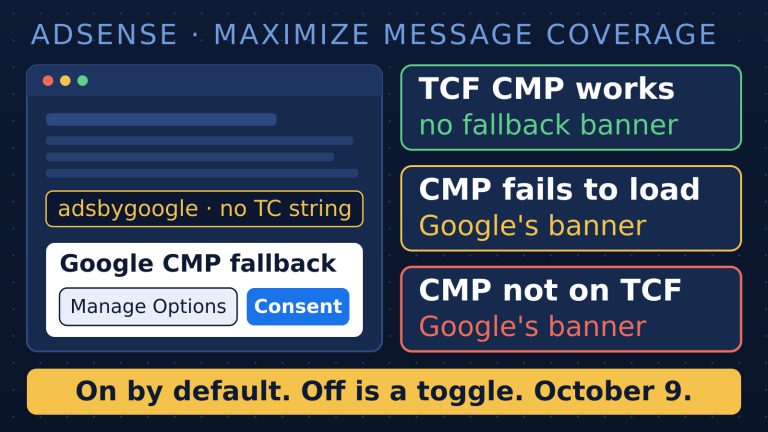
Tapping the button carries a mechanical cost too. The system dismisses the sheet “without recording an answer” and returns notDetermined; the app must call the method again to get an actual accept or deny. Apple permits redirecting the person back to the ATT prompt afterward, with one condition: “you should not redirect users to your ATT prompt if they have opted out of all relevant legal consent choices in the screen or page surfaced.” Consent layers already stack elsewhere in the ad business: once switched on, an account-level setting lets Google serve its own fallback consent banner for AdSense when the adsbygoogle tag finds no TC string on the page.
The device’s advertising identifier stays all zeros for any app until the ATT grant lands, layered prompt or not. It belongs to the same category, the mobile advertising identifier, that four U.S. military components say they disable on government-issued devices, for unrelated reasons.
New API Call, New Info.plist Key
Both are new, and Apple documents the Info.plist key as optional. A new method, requestTrackingAuthorization(usingExpandedInterface:additionalInformationAction:completionHandler:), sits next to the original requestTrackingAuthorization(completionHandler:) call. It takes a boolean for the full-page sheet and an optional closure for the Additional Information button; passing nil omits the button entirely. A parallel Info.plist key, NSUserTrackingMarkdownUsageDescription, sits next to the existing NSUserTrackingUsageDescription string, and accepts Markdown: bold, italic, bullet lists and paragraph breaks, though not underline. Apple’s documentation says it falls back to the plain-text key automatically if the app omits it. Both pages carry a Beta label, tied to iOS and iPadOS 27.2.
| Existing | New (iOS/iPadOS 27.2, beta) |
|---|---|
requestTrackingAuthorization(completionHandler:) |
requestTrackingAuthorization(usingExpandedInterface:additionalInformationAction:completionHandler:) |
NSUserTrackingUsageDescription |
NSUserTrackingMarkdownUsageDescription |
What Apple Hasn’t Said
- No release date for iOS 27.2 or iPadOS 27.2. The first iOS 27.2 developer beta shipped September 16, the same day as the policy update; iOS 27 itself reached everyone on September 14.
- No system wording for the new prompt beyond the “Additional Information” button label. Apple’s pages describe the mechanism, not the prompt’s own on-screen copy.
- Whether the one-year clock also counts answers given before iOS 27.2. The policy page states the rule without a version or a start date.
- How “apps distributed in” the five countries, the policy page’s wording, lines up with the API documentation’s test of device location plus Apple Account country or region.
- Which authorities are party to the agreements. Apple says only “select European competition authorities” and does not say whether the agreements include the Bundeskartellamt’s August decision.
TechCrunch’s report on the agreements ties the shift to a years-long investigation by Germany’s competition authority and other regulators, and notes that the agreements do not remove the obligation to ask users for permission or change when that request must appear. Apple’s own account, in the “ATT in the European Union” section of its developer page on user privacy and data use, is narrower: an alternative prompt with modified formatting and language, the only one available for apps distributed in five countries; the Additional Information layer; and the clock on asking again. The requirements for when an app must seek permission to track, Apple says, “will remain the same.”